John Leonard may not have entered last season as a major storyline for the Detroit Red Wings, but by the end of the year he had quietly become one of the organization’s most intriguing depth players. During a season filled with frustration, injuries, and another late collapse in the standings, Leonard emerged as one of the few consistent positives for Detroit down the stretch.
The Red Wings’ season once again unraveled during the crucial final months. Injuries mounted, the team struggled to maintain momentum, and several players appeared to lose confidence as playoff hopes faded. Despite the disappointment, there were still smaller victories hidden beneath the frustration. Young players such as Marco Kasper began showing signs of growth, while prospects like Emmitt Finnie flashed encouraging potential. Among those positives, however, Leonard’s emergence may have been the most unexpected.
Leonard spent most of the season dominating with the Grand Rapids Griffins in the American Hockey League. In just 47 games, he produced an impressive 54 points while leading the Griffins with 33 goals. His offensive production separated him from the rest of the roster, finishing well ahead of many teammates despite missing time earlier in the season. Every time Grand Rapids needed a goal, Leonard seemed to deliver.
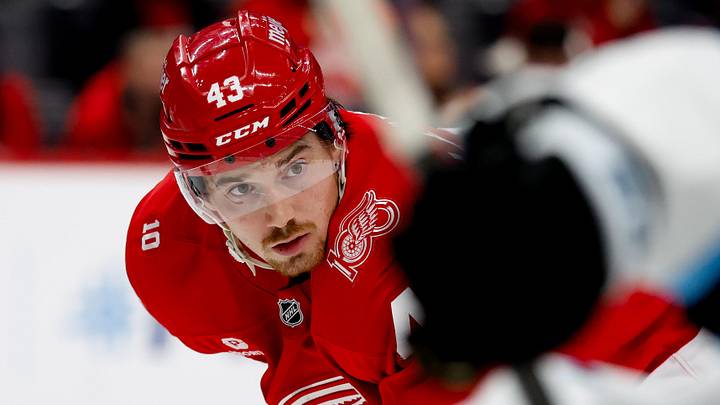
His strong play eventually forced Detroit to take notice. When injuries began piling up with the Red Wings late in the year, Leonard earned an emergency call-up alongside Sheldon Dries and Eduards Tralmaks. Expectations for the group were relatively modest. Detroit simply needed stability and energy while trying to survive a difficult stretch of the season.
Leonard delivered exactly that.
Although the Red Wings ultimately failed to stop their downward spiral, Leonard quickly showed he belonged at the NHL level. In 11 games with Detroit, he recorded four points, including two goals, while consistently playing with energy and urgency. Those numbers may not appear overwhelming at first glance, but they become far more impressive when considering his role and ice time. Leonard averaged roughly 11 minutes per game and often played alongside struggling linemates on a team that had clearly lost momentum.
Even in those circumstances, Leonard stood out.

What made Leonard’s performance especially noticeable was his compete level. As the season drifted toward disappointment, many players on the roster appeared exhausted or mentally checked out. Leonard, meanwhile, approached every shift as though he were trying to earn his NHL future because he was. He played aggressively on the forecheck, attacked loose pucks, and consistently tried to create offense despite limited opportunities.
That mentality likely made a strong impression on Detroit’s coaching staff and front office.
At 27 years old, Leonard is no longer viewed as a developing prospect, which complicates his long-term future with the organization. The former sixth-round pick has already appeared in 81 NHL games across multiple organizations, recording 21 career points. While those numbers do not suggest top-line potential, they do show he can contribute in a depth role when given an opportunity.
More importantly, Leonard appears to have outgrown the AHL level offensively. His production with Grand Rapids showed that he can consistently generate scoring chances and finish plays against minor-league competition. The remaining question is whether he can establish himself as a reliable full-time NHL contributor.
There is certainly evidence suggesting he can.
Modern NHL teams increasingly value hardworking depth forwards who can provide secondary scoring while maintaining responsible defensive play. Leonard fits much of that description. He brings energy, forechecking pressure, and offensive instincts that can help stabilize a bottom-six role. While he may never become a star player, many successful NHL careers are built on exactly those qualities.
The challenge for Leonard is finding the right opportunity.
Detroit’s roster situation remains crowded entering next season. The organization continues prioritizing younger talent as part of its long-term rebuild, and players such as Kasper and Finnie are expected to receive significant developmental opportunities moving forward. Even if the Red Wings make changes to their bottom six during the offseason, available roster spots may still be limited.
That reality could push Leonard toward exploring options elsewhere.

Several rebuilding teams around the league could benefit from a player like Leonard. Organizations such as the Chicago Blackhawks or Nashville Predators may value his combination of NHL experience and AHL scoring success. Younger teams often need veteran depth players capable of helping prospects adjust to professional hockey while still contributing offensively when called upon.
Leonard’s versatility also increases his value. He has experience moving between leagues, understands the demands of both levels, and has shown the ability to stay productive despite inconsistent opportunities. Those qualities can make him attractive to teams searching for affordable, dependable depth options.
Whether Leonard ultimately remains with Detroit or signs elsewhere, his strong finish to the season likely changed the direction of his career. Just months ago, he appeared destined to remain an AHL scorer fighting for occasional NHL call-ups. Now, he looks much closer to becoming a legitimate full-time NHL depth forward.
For a Red Wings season filled with disappointment, that may end up being one of the most important positive developments to emerge from the chaos.