
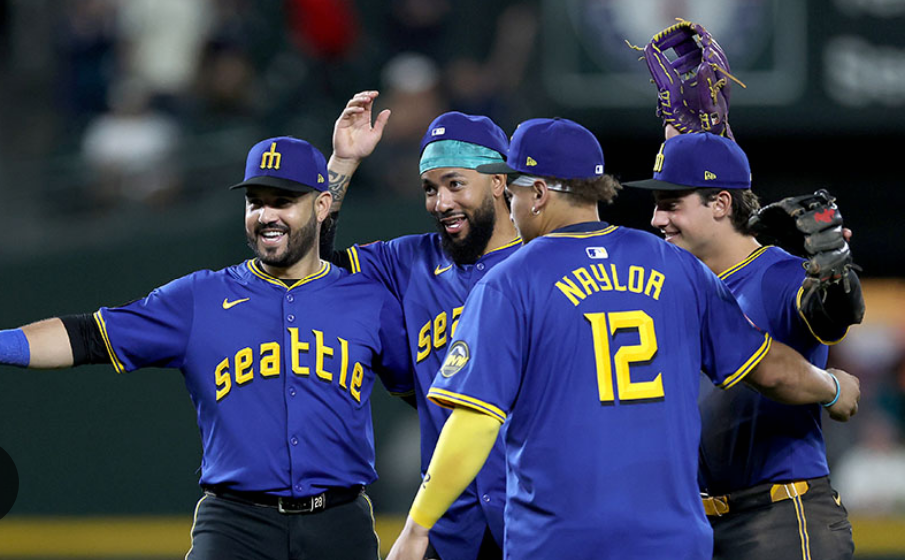
The Seattle Mariners are once again being linked to a bold international move, with projections suggesting the club could sign an overseas star to a five-year, $80 million contract in an effort to reshape its lineup and maintain momentum as a contender. While no deal has been finalized, the prediction has generated significant buzz, reflecting both the Mariners’ evolving approach to roster construction and the growing influence of international talent on Major League Baseball.
At the center of the speculation is Kazuma Okamoto, one of the most accomplished and consistent hitters in Japan’s Nippon Professional Baseball. Okamoto has spent years establishing himself as a middle-of-the-order force overseas, combining power, plate discipline, and durability in a way that naturally attracts MLB interest. For Seattle, a potential pursuit of Okamoto would signal a willingness to invest heavily in proven international production rather than relying solely on internal development or short-term free-agent fixes.

The Mariners enter this offseason at an interesting crossroads. After building their identity around elite pitching and incremental offensive upgrades, Seattle faces questions about how aggressive it should be in adding impact bats. Recent roster turnover, combined with uncertainty at key infield positions, has created a clear opening for a player capable of anchoring the lineup. An international signing of this magnitude would represent both a solution to immediate needs and a long-term commitment to offensive stability.
A five-year, $80 million deal fits neatly into the current market for top-tier international position players. Recent precedent shows that MLB teams are increasingly comfortable making substantial investments in players coming from Japan, especially those with long track records of success. Contracts of this size are often viewed as a balance between upside and risk—large enough to reflect confidence in the player’s ability, but structured to avoid the kind of decade-long commitment that can hamper roster flexibility.

From a baseball perspective, Okamoto’s profile is particularly intriguing for Seattle. He is known for his power to all fields, an approach that could translate well to MLB pitching and mitigate some of the challenges posed by pitcher-friendly home parks. His ability to handle premium velocity and adjust to breaking pitches has been refined over years of facing high-level competition, making scouts optimistic about his transition. Defensively, his experience at corner infield positions would give the Mariners options, allowing them to align their roster based on matchups and health.
Beyond on-field fit, the potential signing reflects a broader organizational philosophy. The Mariners have gradually expanded their presence in the international market, recognizing that global scouting and recruitment are essential for sustained success. Adding a high-profile international star would not only strengthen the roster but also reinforce Seattle’s reputation as a destination for elite talent from outside the United States. That reputation can have ripple effects, influencing future signings and expanding the club’s global footprint.

Financially, a deal of this size would represent a notable commitment, but not an unreasonable one. Seattle has historically been cautious with long-term contracts, prioritizing flexibility and internal development. A five-year agreement allows the team to project costs with clarity while still leaving room to adjust around the margins. If the player performs as expected, the contract could quickly look like a bargain relative to rising league-wide payrolls. If challenges arise, the limited length reduces long-term exposure.
There is also a competitive element at play. Other teams are expected to monitor Okamoto’s availability closely, particularly clubs in need of offensive reinforcement. For Seattle, acting decisively could be crucial. Waiting too long risks losing out to franchises with deeper pockets or more established international pipelines. The prediction of a five-year, $80 million deal suggests that analysts believe Seattle is both willing and able to compete in that market.

From the player’s perspective, Seattle offers a compelling opportunity. The Mariners are positioned to contend, boast one of the league’s strongest pitching staffs, and play in a division that provides a mix of challenges and opportunities. Joining a team on the rise can be appealing, especially for an international player looking to make an immediate impact rather than joining a rebuilding club. The chance to be a focal point of the offense, rather than a complementary piece, could also be a major draw.

Of course, there are inherent risks. Transitioning from international leagues to MLB is rarely seamless. Differences in pitching styles, travel demands, and schedule intensity can test even the most accomplished players. The Mariners would need to invest not only financially but also in support systems to help ensure a smooth adjustment. Past examples across the league show that teams willing to provide strong infrastructure often see better results from international signings.
If the deal were to materialize, it would mark one of the most significant offensive investments in recent Mariners history. Fans, long accustomed to seeing the team lean heavily on pitching, would view the signing as a clear signal of ambition. It would suggest that Seattle is no longer content to simply compete for playoff spots, but is actively seeking the kind of impact talent that can swing postseason series.
Even if the prediction does not come to fruition, the discussion itself highlights a shift in perception. The Mariners are increasingly being mentioned alongside teams expected to make big moves, rather than those sitting on the sidelines. That change reflects years of patient rebuilding, smart drafting, and gradual financial growth.
In the end, whether or not Seattle ultimately signs an international star to a five-year, $80 million deal, the speculation underscores a simple reality: the Mariners are operating with intent. They recognize the narrow windows that define competitive success and appear ready to act decisively when the right opportunity presents itself. If that opportunity comes in the form of a proven international slugger, it could reshape the franchise’s trajectory and signal a new chapter in Seattle’s pursuit of sustained contention.